
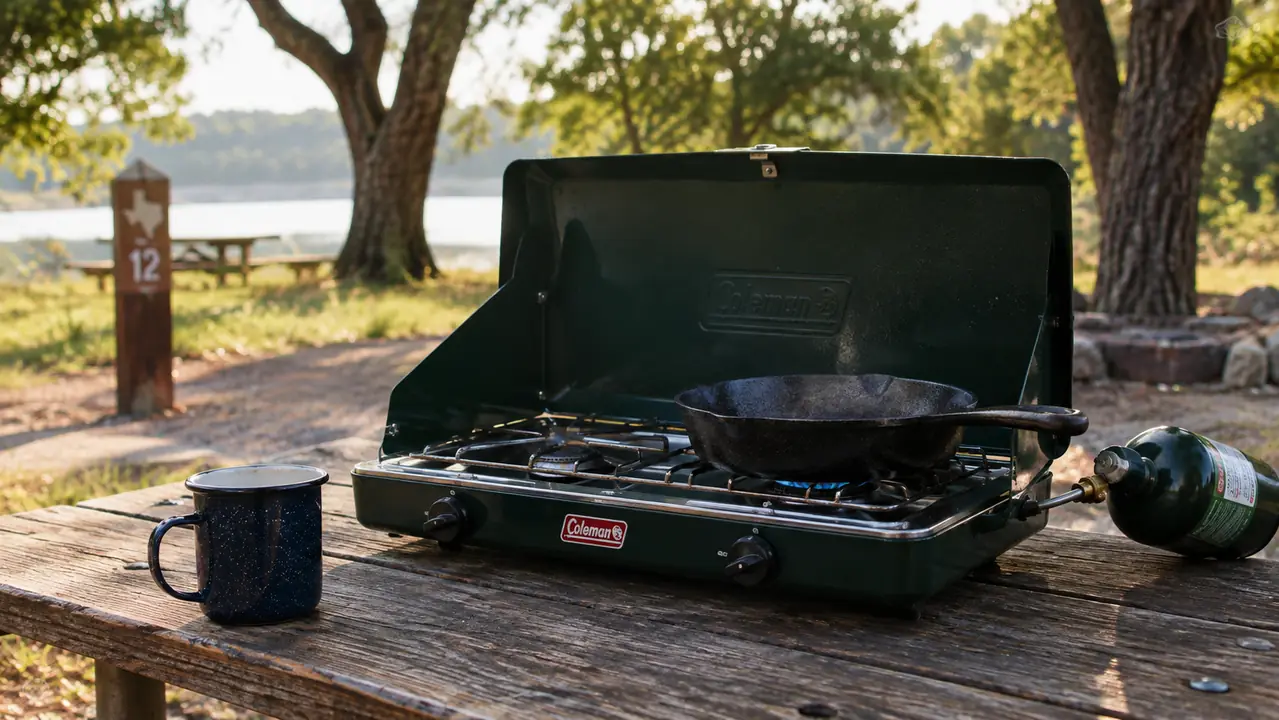
I bought the Coleman Triton 2-Burner Propane Stove in spring 2025 for one simple reason: I was tired of cooking breakfast for three people one egg at a time on a single backpacking canister stove. By October 2026, that Coleman has been to Garner, Pedernales Falls, Guadalupe River, and a week in the Colorado mountains. It has cooked bacon in a cold wind, simmered beans through a storm, and boiled coffee before dawn more times than I can count. This is the long-term review I wish I had found before I bought it.
If you are a weekend car camper like me, you already know the drill. You want a stove that lights fast, boils water fast, and does not fall apart when it rattles around the back of a 2017 Toyota 4Runner for six months. The Coleman Triton has done all of that. It has also taught me a few things about what I actually need from a camp stove, and a couple of things I would happily trade away.
The Quick Verdict
The Coleman Triton is the right stove for most family car campers: two strong burners, simple controls, and a price that makes sense. It is not the lightest or the most precise stove out there, but after a full season it has not given me a single reason to switch.
Amazon Check Today's Price →The stove that cooked breakfast for three all season
After six months and four trips, the Coleman Triton is still the first thing I pack. Two burners, easy lighting, and it has never once let us eat cold oatmeal.
Amazon Check Today's Price on Amazon →How I've Used It
I am Tess Calloway. I live in the Texas Hill Country outside San Antonio, and I car camp out of a 2017 Toyota 4Runner with my husband Wade and our 14-year-old son Eli. We are not ultralight backpackers and I have never claimed to be. We are the family at the campsite with the big tent, the camp chairs with coolers, and a cooler full of food that someone has to actually cook.
Before the Coleman Triton, I used a single-burner backpacking canister stove. It boiled water fine. It could not cook bacon, eggs, and coffee at the same time, which meant breakfast took over an hour and the first person to eat was cold by the time the third plate was done. I bought the Triton in spring 2025 specifically to fix that. Since then it has cooked roughly 20 camp breakfasts, a dozen dinners, and countless cups of coffee across Garner, Pedernales Falls, Guadalupe River, and a week in the Colorado mountains.
I did not baby it. The stove rode in the back of the 4Runner loose, got set up on picnic tables, gravel, and once on the tailgate during a light rain. I cleaned the drip trays when I remembered, which was not every trip. I want to know what this stove does for a normal family that camps a few times a season, not what it does in a lab.
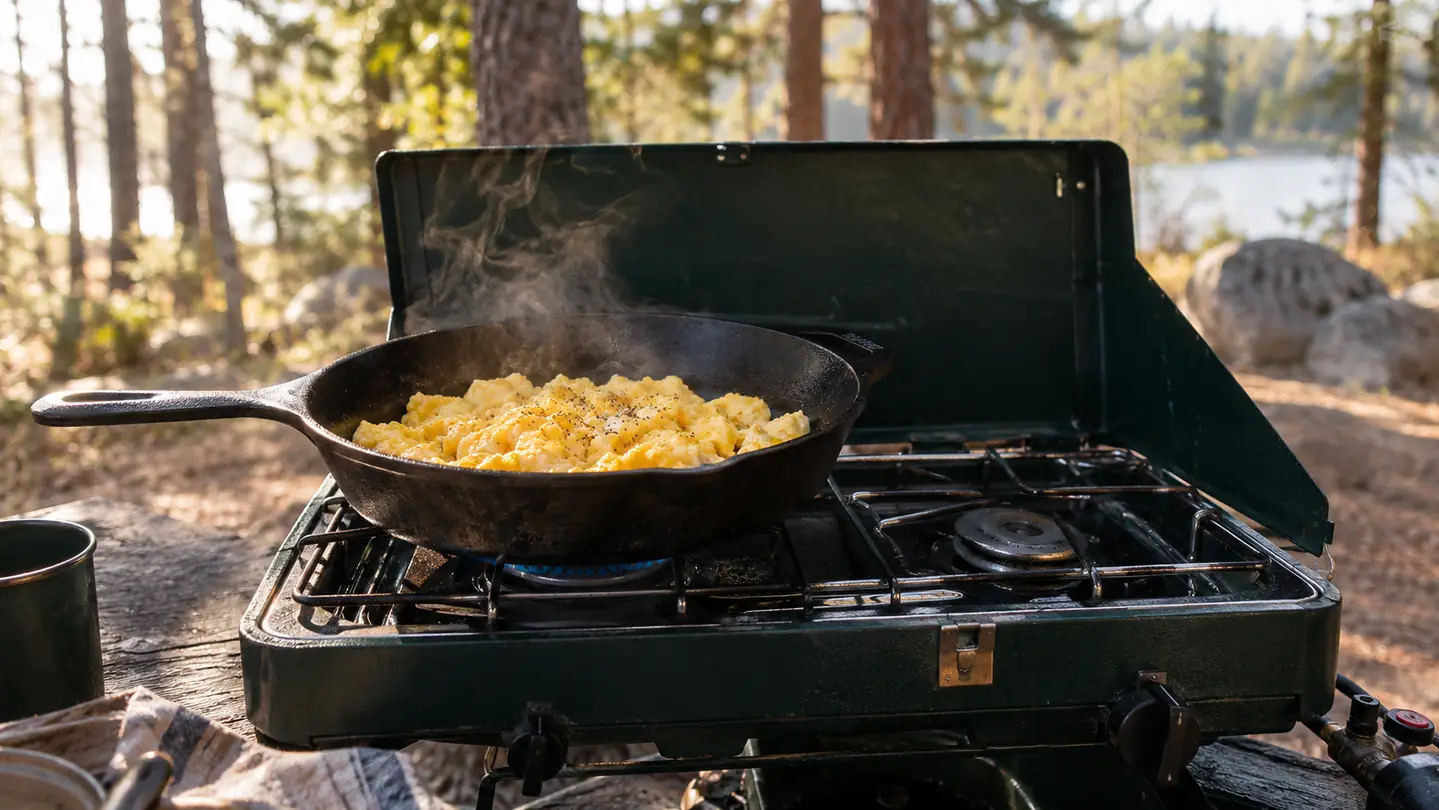
The first real test was Easter weekend at Garner State Park in April 2025. The wind came up hard that Saturday and the old single burner took 20 minutes to boil water for coffee while we stood around shivering. The Triton changed the whole morning. Bacon went on the big burner, eggs went on the small one, and the coffee was ready before the bacon finished. We ate together, at the same table, while the food was still hot. That is the moment I stopped wondering whether the upgrade was worth it.
Setup takes about two minutes. The stove folds out, the two legs lock into place with a click, and the propane canister screws onto the regulator with about three full turns. I check the gasket first, then open the valve slowly and light the burner before I turn it up. On the first trip I timed it out of curiosity: 1 minute 40 seconds from the back of the 4Runner to a lit burner. By the fourth trip I stopped timing it because it had become automatic.
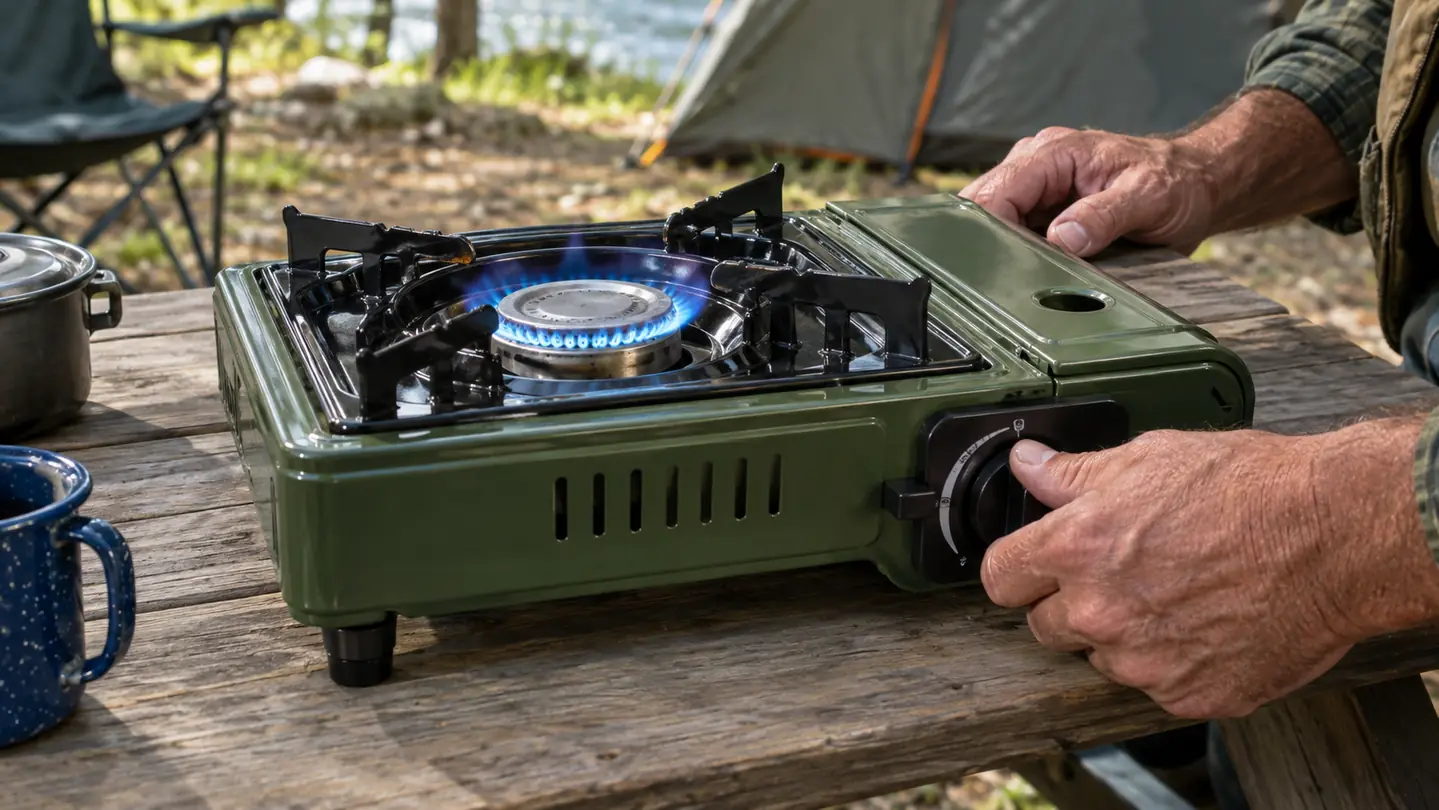
What the Two Burners Actually Do for You
The whole point of a two-burner stove is that you can cook a real meal, not just boil water. The Coleman Triton delivers on that. The left burner puts out 20,000 BTUs and the right burner 15,000 BTUs, which means you can run a 12-inch cast iron skillet on the left and a saucepan on the right at the same time. I have done bacon on the left and eggs on the right, and I have done a pot of beans on the left while cornbread baked in a covered skillet on the right.
That BTU difference matters more than I expected. The big burner is the workhorse for searing and boiling. The smaller burner is the one I use for simmering, and it holds a gentle bubble far better than the single-burner stove ever did. I made a pot of red beans on the Triton at Pedernales Falls and did not scorch them once, which is more than I can say for my own kitchen stove.
The wind panels are the feature I did not know I needed. Texas Hill Country evenings get breezy, and a gust can turn a good flame into a weak orange flicker. The Triton's three panels fold up around the burners and knock the wind down enough that I stopped hunting for the perfect sheltered spot on the table. I still face the stove away from the wind when I can, but the panels buy me a lot of margin.
The Colorado trip in July was the real stress test. We cooked for three people for seven days at 8,000 feet, where water boils at a lower temperature and everything takes longer. The Triton handled pancakes for three on the big burner while the small burner kept a pot of sausage gravy warm. I used a 10-inch skillet and got through a batch of six pancakes in about four minutes. By the end of the week I had stopped timing it and just cooked.
The dinner that sold Wade on the stove was fajitas at Pedernales in October. I sliced two pounds of chicken and beef at home, and at the campsite the big burner got a cast iron skillet screaming hot while the small burner warmed a stack of tortillas in foil. The meat seared in batches of about six minutes each, and the tortillas stayed soft the whole time. We ate at the table with the stove still warm beside us, and cleanup was one skillet and one foil packet.
The first morning I cooked bacon, eggs, and coffee at the same time, I actually laughed out loud. That had never happened on the old single burner.
Lighting, Heat Control, and the Things That Annoy Me
The Triton lights with a push-button igniter. I have used it maybe 40 times and it has failed twice, both times in a cold wind when the burner was wet from rain. The fix took five seconds with a lighter, but it is worth knowing that the igniter is not magic. If you camp in wet weather, carry a lighter as a backup. It is a small thing and it has never ruined a meal, but it is real.
Heat control is good but not infinite. The dials have detents, so you get a few clear settings rather than a smooth sweep. I found the low setting on the right burner perfect for simmering, and the high setting on the left perfect for boiling a pot of water in about four minutes. What you do not get is fine temperature control for something like melting chocolate. That is not what this stove is for, and I have stopped expecting it to be.
The things that annoy me are small. The fuel canister sits exposed on the side, which means you have to be careful where you put the stove on a crowded table. The carrying handle works but the stove is not what I would call light. And the drip trays catch spills fine but are a pain to get fully clean. None of that changes how I feel about the stove. It is just the honest list of what I noticed.
The coldest morning was at Guadalupe River in January 2026. It was 38 degrees and damp, and the igniter clicked three times without catching. I had a butane lighter in my jacket pocket from the night before, so the stove was burning in under ten seconds. That is the whole story: the igniter failed, the backup worked, breakfast happened on time. I now keep a lighter clipped inside the lid of the stove case so I never have to hunt for it in the dark.
I tracked fuel use one weekend out of curiosity. A fresh 16-ounce propane canister ran the stove for two full days of breakfast and dinner for three people, plus coffee each morning, and still had enough left for a quick lunch on day three. I have never run out mid-meal, because I swap in a fresh canister at the start of any trip longer than two nights.
How It Held Up Over a Season
I have owned the Coleman Triton since spring 2025, so it has been through a full Texas summer, a Colorado mountain trip, and the start of fall. The finish has held up. There is a small scratch on the lid from where it slid against a cooler in the back of the 4Runner, and the rubber feet are a little dusty, but everything that matters still works exactly like it did on day one.
The regulator and hose have given me no trouble. I have connected and disconnected the propane canister maybe 25 times and the connection still feels tight and secure. The one thing I do every trip is check the rubber gasket on the canister for cracks, and so far it looks brand new. That is the kind of maintenance that takes ten seconds and prevents the kind of leak you do not want to find at a campsite.
The stove has also survived the things I did not plan. A sudden storm at Garner soaked the table and the stove got rained on before we could get it under the awning. I dried it off, let it air out overnight, and it lit fine the next morning. A friend's dog knocked it off a low table once and it landed on gravel. The lid took the hit, and the latch still closes clean. I am not saying you should drop yours. I am saying this one is not fragile.
My maintenance routine is simple. Every third trip I take the drip trays out and wash them in hot soapy water to get the grease film off. I wipe the burner tubes with a dry cloth and check that the little holes are not clogged. Twice a season I unscrew the regulator from the canister and look at the threads for dirt. That is it. Ten minutes of attention every few trips, and the stove has never once failed to light when I needed it.
Who This Is For
The Coleman Triton is for the family that camps a few times a season and wants to cook real food without a PhD in stove operation. It is for the person who is tired of cold cereal because the single burner can only boil water. It is for the weekend car camper who wants two burners, a simple igniter, and a stove that does not need its own dedicated carrying case to survive the drive to the park.
If that sounds like you, this is probably the stove you should buy. It is not the cheapest two-burner Coleman makes, but it is the one that cooks like a real stove, and after a season of use I would spend the difference again.
Who Should Skip It
Skip the Triton if you are a backpacker who needs to carry your stove on your back. At this weight, it belongs in a car, not a pack. Skip it if you need precise low-temperature control for things like sauces or melting, because the dials are not built for that. And skip it if you camp mostly in places where you cannot use propane, because this stove is propane and that is not negotiable.
I would also tell a solo camper to think twice. If you cook for one, a single burner is lighter, cheaper, and easier to pack. The Triton's second burner only earns its space when there is more than one plate to fill.
What I Liked
- Two strong burners let you cook a full breakfast or dinner at once
- Push-button igniter worked almost every time, even in wind
- Fold-up wind panels make a real difference on breezy Texas evenings
- Survived a full season of rough handling, rain, and a drop onto gravel
- Simple controls that a kid or a tired adult can figure out fast
Where It Falls Short
- Heavy enough that I would not want to carry it far from the car
- Igniter needs a backup lighter in wet or very cold conditions
- Dial detents mean no fine temperature control for delicate cooking
- Exposed propane canister on the side takes up table space
Still the first thing I pack after a season of use
The Coleman Triton has cooked 20 breakfasts, a dozen dinners, and survived Texas weather. If you camp out of a car, this is the stove I would buy again tomorrow.
Amazon Check Today's Price on Amazon →