
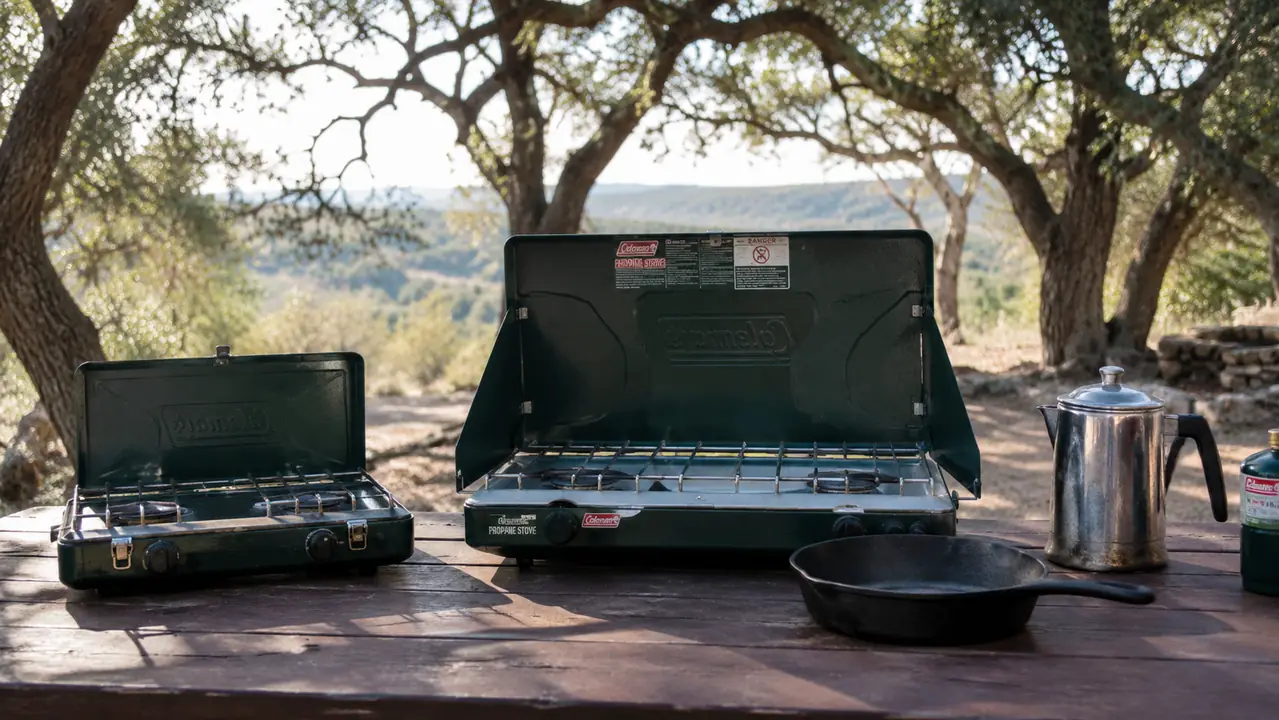
For the last year and a half, the Coleman Triton has been the stove that actually gets breakfast on the table at Garner State Park. Before I bought it in spring 2025, I cooked for my family on a single-burner backpacking canister stove, which meant eggs first, then pancakes, then coffee, one pan at a time, while Wade and Eli stood around waiting. The eggs sat under a lid and went cold while the pancakes cooked, and the coffee came last, which is the wrong order for everyone. By the time the last plate hit the table, Eli had already finished his first one. When I finally decided to upgrade, I went back and forth between the Coleman Triton and the Camp Chef Everest. Both are two-burner propane stoves that car campers swear by. Both will cook a full breakfast for three people. But they are not the same stove, and after using the Triton through two Texas summers, a Guadalupe River trip, and a cold week in the Colorado mountains, I have a clear answer.
The short answer is that the Coleman Triton is the better buy for most families who car camp a few weekends a season. It packs smaller, weighs less, and does everything a family of three needs without fuss. The Camp Chef Everest is the better stove if you cook for a crowd, cook in serious wind, or want the biggest cooking surface that will still fit in the back of a vehicle. Neither choice is wrong, and I have recommended both to different friends. The right one just depends on how you actually camp.
I compared these two specifically because they are the two stoves people actually ask me about at the campsite. The Triton is the one I pull out of my 4Runner. The Everest belongs to my friend, and we have camped together enough that I have cooked on both at the same table, with the same fuel and the same pans. Both stoves have been around for years, and both have thousands of owner reviews. That tells you they work. What it does not tell you is which one fits your campsite, and that is what this comparison is for.
| Coleman Triton | Camp Chef Everest | |
|---|---|---|
| Price | Costs less, and the price is fair for what it does | Costs more, mostly for the extra output |
| Cooking Power | 20,000 total BTU, plenty for a family breakfast | 40,000 total BTU, roughly double the heat |
| Cooking Surface | Fits a 10-inch skillet plus a small pan | Fits a 12-inch skillet next to a saucepan |
| Weight and Pack Size | Light enough to carry in one hand, tucks behind the seat | Heavier and bulkier, takes a dedicated spot in the cargo area |
| Wind Performance | Flip-up wind guards help in a light breeze | Big flame shrugs off gusts that make the Triton flicker |
| Build Quality | Folded steel, no rattles after a season and a half | Same sturdy construction, built for years of abuse |
| Ease of Cleaning | Grates and drip tray lift out, quick wipe down | Works the same way, just more surface to scrub |
| Best For | Families of three or four packing one vehicle | Groups of six or more who cook in one big batch |
How I Tested Both Stoves
I tested both stoves the way most families actually camp, not the way a lab would. Breakfast is the hard test. Bacon and eggs in one cast iron skillet, a percolator of coffee on the other burner, and a 14-year-old who wants to eat before the fish start biting. I ran that same routine on both stoves more times than I can count, and I paid attention to the things that annoy you at 7 in the morning: how fast the water boils, how even the flame is, and whether the stove stays lit when the wind picks up.
I also took both through the conditions that make a stove earn its keep. A windy evening at Pedernales Falls, where the gusts come down the canyon and flatten a flame if they can. A cold morning in the Colorado mountains with the temperature below freezing. The thermometer in the 4Runner read 28 degrees that morning, and I timed both stoves boiling two cups of water for coffee. The Triton took about four and a half minutes. The Everest did the same job in just under three. Ninety seconds does not sound like much, but it is a long time when you are standing around in a coat waiting for your first cup. Then a rainy afternoon at Guadalupe River where I cooked under the tailgate of the 4Runner. Those trips are the ones that separate a stove you like from a stove you trust, and they are the reason I feel confident telling you which one to buy.
One note on fairness. The Everest is not mine, so I did not live with it the way I live with the Triton. But I have packed it, carried it, cleaned it, and cooked on it enough to know its strengths and its costs. I think that is a fair basis for a recommendation, and I will tell you exactly where each stove beats the other.
Over the course of those tests, I kept a short list of what matters to me in a camp stove. It has to light easily, hold a steady simmer, boil water fast enough that nobody wanders off, and fold up small enough that it does not argue with the rest of the gear. Everything else is a bonus. I judged both stoves against that list, not against each other's spec sheets.
What the Specs Don't Tell You
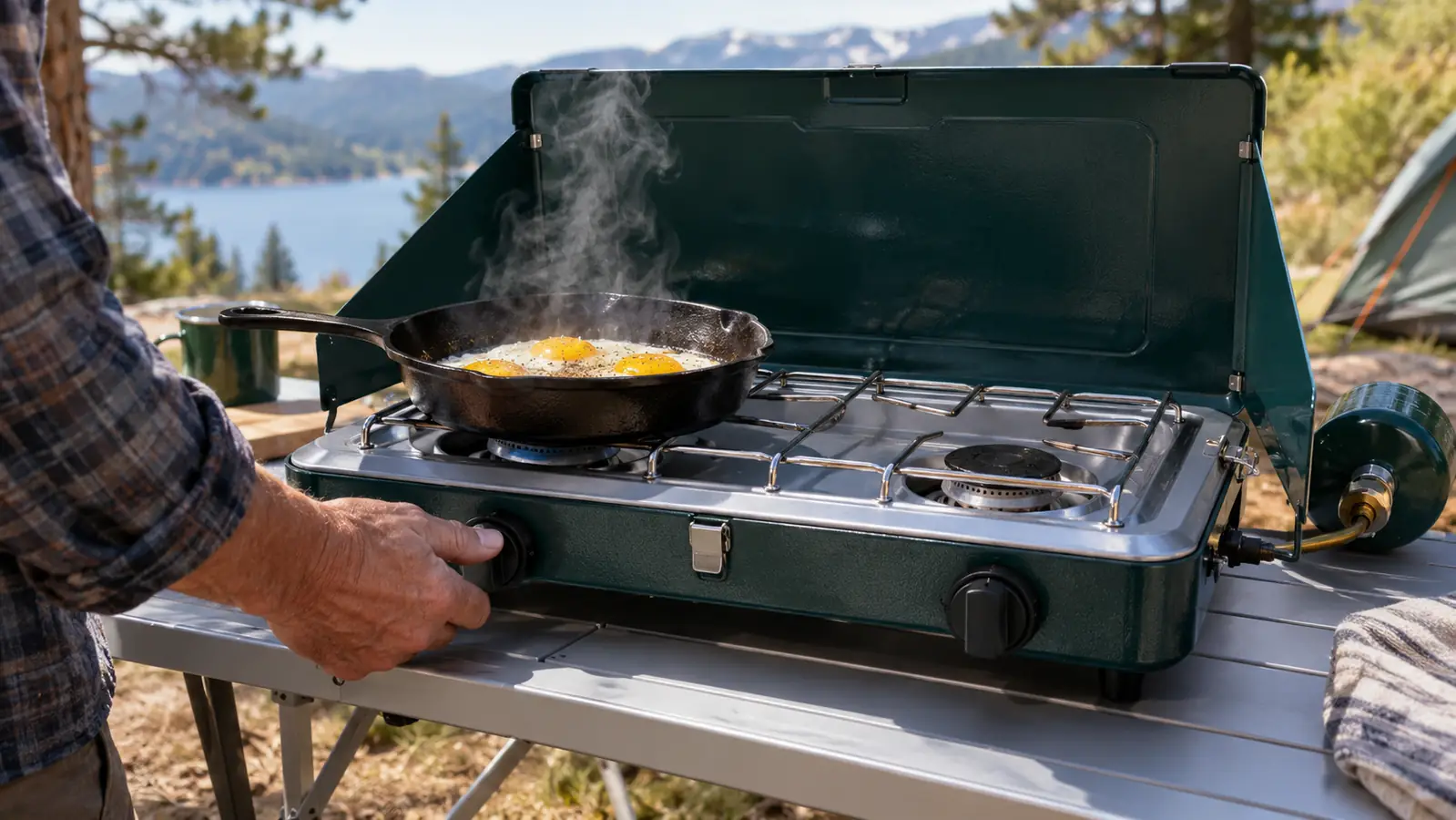
The spec sheet says the Everest puts out roughly twice the heat of the Triton, and that is true. What the spec sheet does not say is what that means at 7 in the morning when you are half awake and the coffee is not ready yet. The Triton heats a 10-inch skillet just fine. The Everest heats a 12-inch skillet faster and keeps it hot even when you load it with cold meat. For a family of three, the Triton pace is never a problem. For a group, the Everest pace is the whole point.
The other thing the spec sheet misses is flame behavior in wind. Both stoves have wind guards. The Triton guards flip up in one motion and handle a light breeze. The Everest guards do the same job, but the flame is big enough that it shrugs off gusts that make the Triton flicker. I saw it on a Saturday at Pedernales Falls when the wind came down the canyon hard enough to scatter napkins off the table. I turned the Triton so its guards faced the gusts, and the flame still flickered. The Everest, sitting right next to it on the same table with the same fuel, kept a steady flame the whole time. If you camp in sheltered spots, you will never notice. If you camp on an exposed ridge, you will notice on the first windy morning.
Where Coleman Wins
The Triton wins the argument that happens before you even leave the house. It is light enough to carry in one hand, and it folds into a compact case that tucks behind the back seat of my 4Runner. The Everest is heavier and bulkier, and it takes a dedicated spot in the cargo area. For a family that packs one vehicle, that difference matters on every single trip, not just the first one.
The Triton also costs less, and the price is fair because the stove does its job without drama. The controls are simple, the flame adjusts in a smooth range from simmer to full, and the built-in wind guards flip up in one motion. And because it costs less, it is the stove you do not have to baby. I do not worry about a scratch on the case or a splash of bacon grease on the top. It is gear, not a showpiece, and it behaves that way.
Day to day, the Triton is the stove I reach for without thinking. It lives in the 4Runner between trips, so it is always ready. It rides behind the back seat, wedged between the tent bag and the folding chairs, and I can pull it out in one motion without shifting anything else. The Everest needs a dedicated spot in the cargo area, and getting it out means moving the cooler and the camp box first. That difference shows up on every trip, not just the first one. When we stop at a campsite, it is on the table and burning before Wade has finished leveling the tent. That ease is hard to put a number on, but it is the reason the Triton gets used and the Everest stays in my friend's garage until he plans a big group trip.
Where the Camp Chef Everest Wins
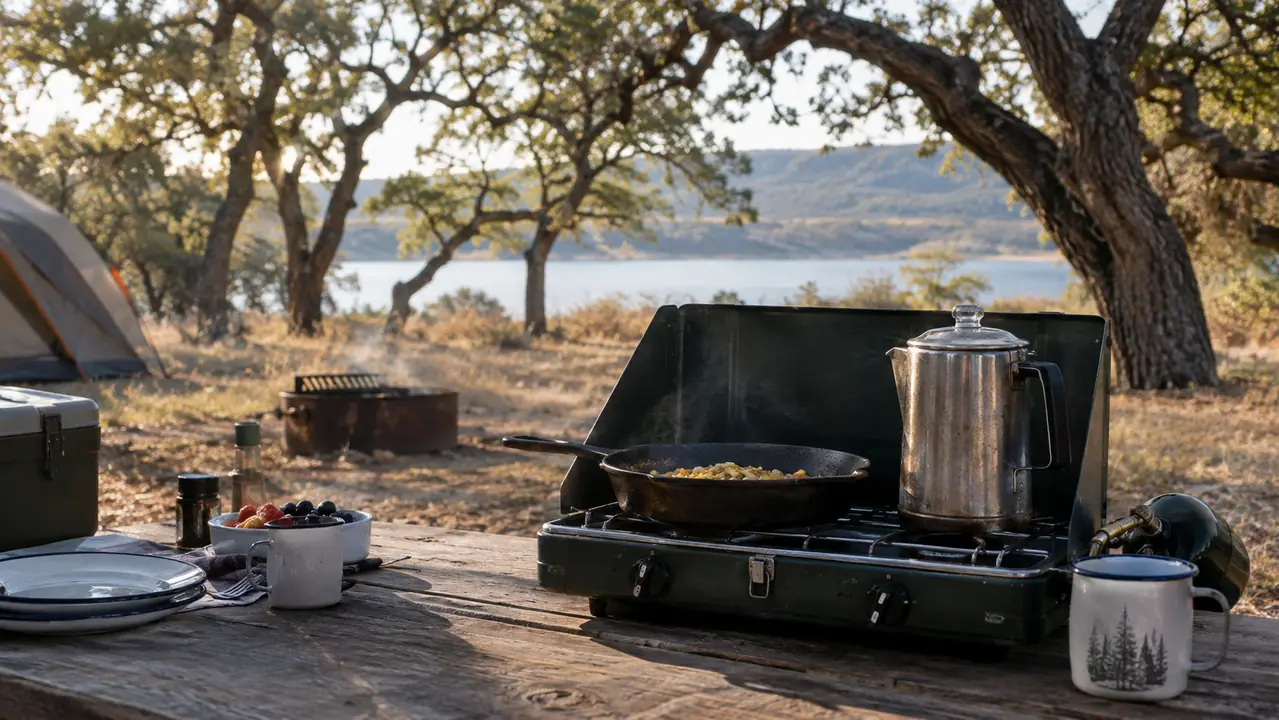
When the Everest is on the table, it is the stove everyone gathers around. Each burner puts out roughly twice the heat of a Triton burner, which means a big cast iron skillet comes up to temperature fast and stays there even when you add a pound of cold bacon. The cooking surface is wider too, so you can run a 12-inch skillet next to a saucepan without playing Tetris. On the Colorado trip, my friend cooked eggs, sausage, and a pot of oatmeal at the same time while I waited for a free burner. That extra room changes how you cook, because you stop sequencing and start cooking everything at once.
The Everest is also the stove to bring when you are cooking for more than your own household. It handles wind better because the flame is big enough to shrug off gusts that make the Triton flicker. If you host the campsite breakfast for six or eight people, the extra output is not a luxury. It is the difference between serving everyone at once and serving them in shifts.
The honest tradeoff is that the Everest makes you pay for that power every time you pick it up. It is heavier, bulkier, and more expensive. If you cook for a crowd every trip, that cost is easy to justify. If you cook for three people most of the time, you are carrying a lot of stove for a job a smaller one does fine.
You don't need the bigger stove to cook a better breakfast.
The Coleman Triton has handled every meal I have thrown at it for a season and a half, and it packs small enough that I never leave it home. If you camp with a household of three or four, this is the stove I would buy again tomorrow.
Amazon Check Today's Price on Amazon →Who Should Buy Which
Buy the Coleman Triton if you are the family cook for three or four people, you pack your gear into a single vehicle, and you want a stove that is light enough to grab without thinking. That is most car campers, and it is why the Triton is the stove I recommend when friends ask. The Triton is not the most powerful stove on the market, and I am not going to pretend it is. It is the most dependable stove for the way most families actually camp, and dependability is the thing I care about most.
Buy the Camp Chef Everest if you regularly cook for a group of six or more, you camp in exposed spots where wind is a constant, or you want the biggest, most powerful two-burner stove that will still fit in a car. Both are good stoves. The right one depends on how many people you feed and how much gear you are willing to carry.
If you are still deciding, think about the last three camping trips you actually took. If most of them were you, your partner, and a kid, the Triton is the answer. If half of them involved another family or a group of friends, the Everest's extra output will get used. The good news is you cannot make a bad choice here. The bad news is you can make the wrong one for your specific setup, and that is what this comparison is for.
One more thing I have learned from a season and a half of camping with both stoves: the best stove is the one you actually bring. The Triton comes with me on every trip because it is easy to grab. The Everest stays home unless I know I need it. A more powerful stove that sits in the garage does you no good at the campsite, and that single fact is why the Triton wins the spot in my 4Runner.
The stove that has earned its spot in my 4Runner.
After two Texas summers, river trips, and a cold week in the mountains, the Coleman Triton is still the first thing I pack. See today's price and current owner reviews on Amazon.
Amazon Check Today's Price on Amazon →