
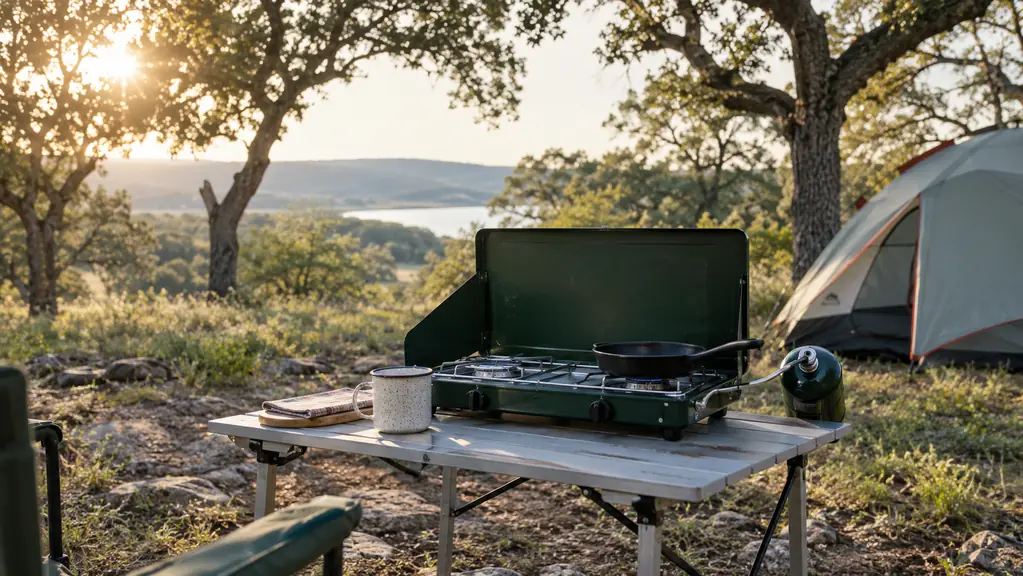
I used to be a fire purist. For my first few years of car camping, everything got cooked over the coals, and I defended that choice like it was a personality trait. Then we started camping as a family of three, and breakfast became a relay race: eggs for Eli, then eggs for Wade, then my coffee, and by the time I sat down with a plate, the first one was cold. Last spring I bought a Coleman Triton 2-burner propane stove, and it changed our trips more than any tent or cooler we own. I did not expect that. I expected a boring appliance. I got the most useful piece of gear in the 4Runner.
This is not a full review of the Triton, though I will get into how it has held up over a year and a half. It is the case for why a two-burner propane stove belongs at every car campsite, even if you love a fire. We still build one most nights. We just stopped making it do all the cooking.
Tired of eating dinner at 9 PM?
The Coleman Triton has been on every trip since spring 2025, from Garner in July to the Colorado mountains in October. It lights fast, holds a simmer, and packs flat in the back of the 4Runner.
Amazon Check Today's Price on Amazon →The 10 Reasons
Breakfast for three, all at once
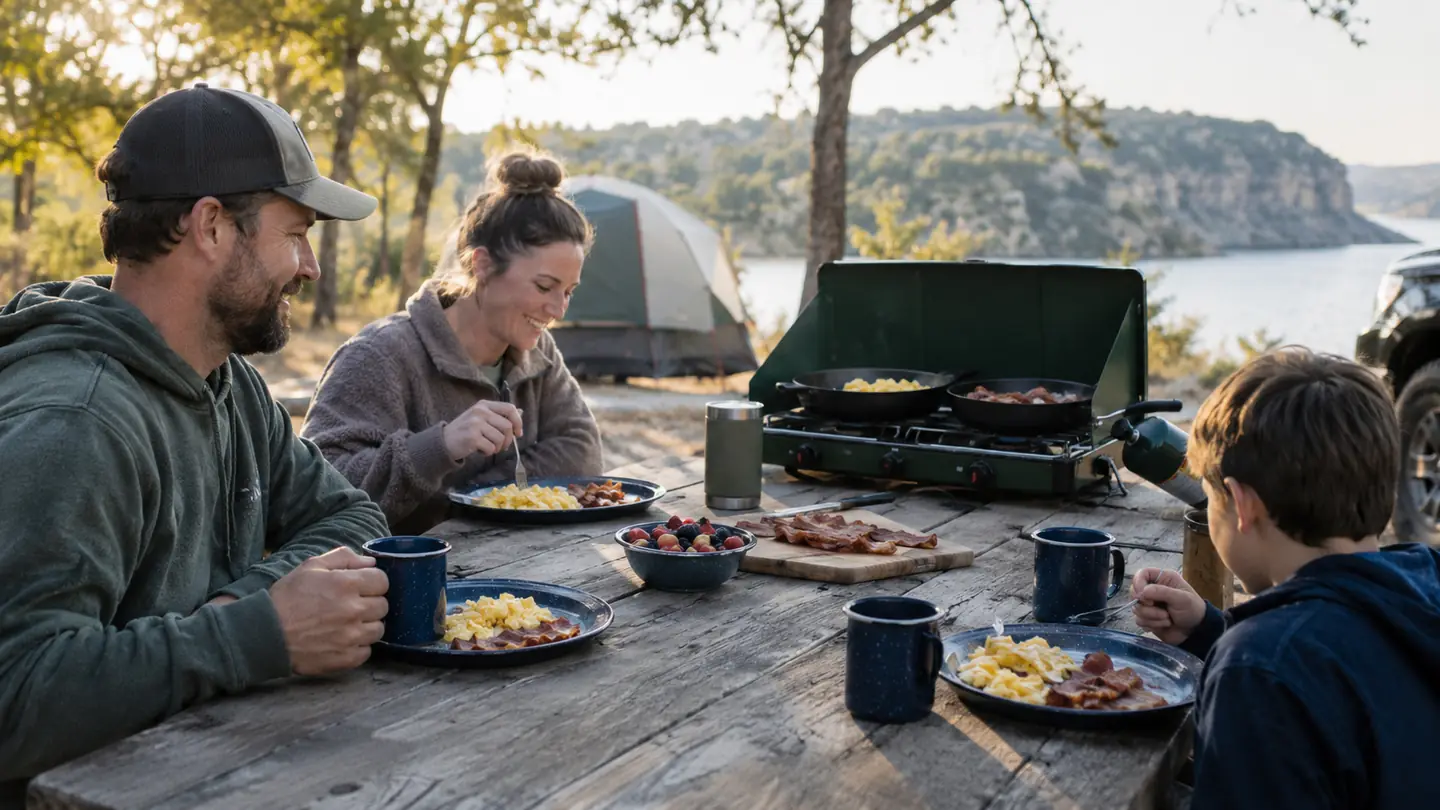
The single-burner canister stove we used before could cook one thing at a time, which meant three rounds of eggs and a cup of coffee that went cold while I waited. Two burners fix that completely. Bacon goes on the left, eggs and coffee on the right, and we all sit down together. It sounds small. It is not small when you are standing in the dark at 7 AM trying to get a teenager fed before the hike. We have done this at Garner, at Pedernales, and in the Colorado mountains, and it works the same every time.
Dinner at a reasonable hour
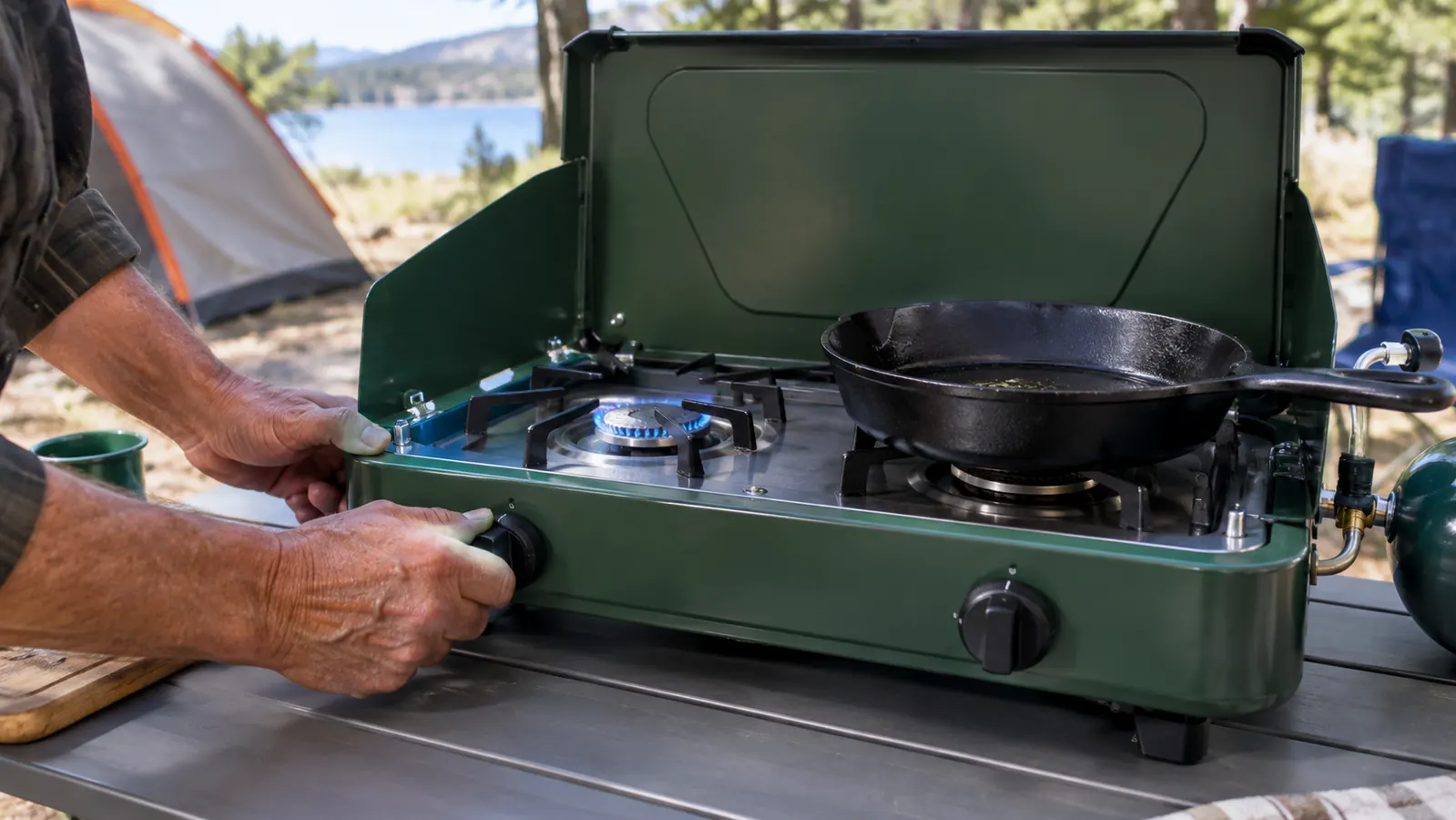
A fire needs twenty or thirty minutes to become coals, and that is on a good night. On a travel day we roll into the park late, and the propane stove is cooking within two minutes of the tent going up. We ate dinner before dark on our last Guadalupe River trip, which had never happened when the fire was the kitchen. The fire also needs someone to watch it the whole time. The stove just sits there and cooks.
Heat you can actually control
A campfire has two settings: roaring and dying. A two-burner stove holds a simmer, boils water at a predictable rate, and does not surprise you. Red beans cook without scorching, and the water for coffee is ready when I expect it to be. Cooking over fire is a skill you have to babysit. Cooking on propane is just cooking, and after a long day of hiking, that is the version I want.
Food that does not taste like smoke
Eggs cooked over mesquite taste like mesquite. Sometimes that is exactly what you want, and sometimes it is Tuesday night and you just want eggs. On the stove, the eggs taste like eggs, the bacon tastes like bacon, and nobody is coughing on the smoke blowing into the picnic table. We still smoke things over the fire on purpose. We just stopped doing it by accident.
It cooks in weather that kills a fire
On a Pedernales Falls trip last spring, the rain moved in at noon and the wood was wet by three. The fire pit sat full of soaked logs while dinner cooked under the canopy on the stove. We ate chili and cornbread at a dry picnic table while the rain did its thing. That is the whole argument in one afternoon. A propane stove does not care about humidity, and it lights on the first click even when everything else in camp is damp. The windshields help too, which I did not expect to care about until I did.
A safer setup with a teenager around
Eli is fourteen and actually helps cook now, which I love. A contained burner with a stable base is a lot easier for a kid to manage than an open fire with a pan of hot grease. No sparks popping, no reaching over flames, no surprise flare-ups. The stove sits low and solid on the table, and the knobs are simple enough that he can handle dinner on his own. That independence is worth a lot by itself.
Dinner still happens during burn bans
Texas summers mean county burn bans, and some parks restrict open fires entirely. A propane stove is still allowed when the fire pit is not, so the trip does not become a cold-meal weekend. We keep the menu the same and just cook on the stove. That alone has saved more than one July trip to Garner, where the fire rings sit unused but the campsites are full of people eating real dinners.
Fuel you can actually count on
Firewood at a park is a gamble: it might be wet, it might be the wrong size, it might be sold out by the time we arrive. Propane is predictable. One fresh cylinder gets us through a long weekend of two meals a day, and a spare in the 4Runner means we always know where we stand. I have never once stood over a propane stove wondering if it would burn. I cannot say that about a stack of park wood.
Less cleanup, less soot
Pans that cook over a fire come home with black on the bottom and ash in the food. Pans that cook on the stove come home almost clean. The grate wipes down in a minute, the burners are easy to brush off, and we are not scrubbing the cast iron at midnight. Camp cleanup is short enough now that we actually do it before bed instead of leaving it for morning.
The fire goes back to being the fire
This is the reason I would have laughed at five years ago, and it is the one I care about most. When the stove does the cooking, the fire gets to be the thing it is actually good at: a place to sit, a place to talk, a place to burn marshmallows. The evening fire went from being my kitchen to being our gathering spot. Eli now asks for the stove to be set up first, before the tent, because he knows what it means for dinner. That is a better trade than any gear upgrade I can name.
What I'd Skip
If you are a solo backpacker, a two-burner stove is overkill, and the weight will annoy you on every mile. If you mostly eat sandwiches and camp store food, you do not need a stove at all. And if the whole point of your trip is cooking over coals, then keep doing that, honestly. The stove is for people who want the fire for the evening and want dinner to just happen. That was us. It might not be you.
A few honest notes from a year and a half with the Triton. It needs a flat, sturdy surface, so we use the camp table, never the ground. It is not the lightest thing in the 4Runner, but we are car camping, so that barely matters. And a propane cylinder runs out at the worst possible moment if you do not carry a spare. We carry two now. That is the whole list of complaints.
The morning we made bacon, eggs, and coffee for three in under twenty minutes, I knew the single burner was never coming back.
Look, I still love a campfire. I will never stop building one. But the stove made our trips calmer and our food better, and it saved us money on firewood within a single summer. If you are on the fence because cooking over the fire feels more like camping, I get it. Cook one meal over the coals and let the stove handle the rest. That is the best of both.
If you cook at camp even half the time, this is the upgrade.
A year and a half in, the Coleman Triton is still the first thing out of the 4Runner and the last thing packed. It has cooked breakfast in July heat and dinner in a Colorado cold snap, and it has never once let us down.
Amazon Check Today's Price on Amazon →