
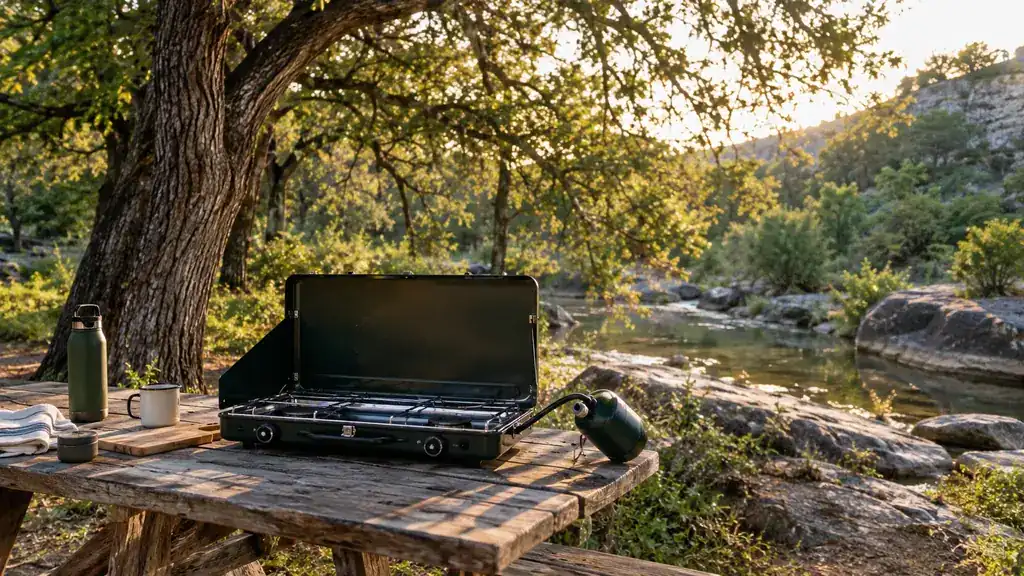
I will start with the part nobody puts in the product photos: the Coleman Triton is a good stove with a few honest flaws, and you should buy it anyway. I have used ours on roughly a dozen trips since we bought it in spring 2025, from Garner and Pedernales Falls to a cold week in the Colorado mountains, and it has cooked breakfast for three people almost every single morning without complaint. It also has a grate that rattles, a regulator that can hiss when the tank is low, and a carry handle that gets hot if you grab it wrong. None of that changes my answer, but somebody should have told me before I bought it, so here is the full picture.
The Quick Verdict
The best value two-burner stove I have used for family car camping, as long as you know its two quirks going in: the grate rattles and the regulator hisses when the propane runs low.
Amazon Check Today's Price →The stove that has cooked 40+ camp breakfasts without a single failure
After a season and a half of Texas weekends and one Colorado trip, the Coleman Triton is still the first thing I pack. Check today's price on Amazon and see if it fits your campsite.
Amazon Check Today's Price on Amazon →How I Have Used It
We bought the Coleman Triton in spring 2025 to replace a single-burner backpacking canister stove that simply could not cook breakfast for three. My husband Wade, our 14-year-old son Eli, and I car-camp out of our 2017 4Runner, mostly at Texas state parks, and the old setup meant one person cooked while the other two stood around holding plates. The Triton changed that on the first trip: two real burners, both running at once, eggs on one side and coffee on the other.
Since then it has been on every camping trip we have taken. That includes hot Garner weekends where the air is thick by 9 a.m., a sudden thunderstorm at Pedernales Falls where we cooked under the rain fly, and a week in the Colorado mountains where the temperature sat below freezing at breakfast. The stove lit on the first try every time, which is more than I can say for the old canister setup on cold mornings.
I want to be clear about what this review is not. I am not a thru-hiker and I do not pretend to be one. I am a 46-year-old weekend camper who wants coffee before the kids get restless, and I tested this stove the way most families actually use it: on a picnic table, on a tailgate, in the wind, in the rain, and once on a very wobbly camp table that I will never use again.
What Nobody Tells You Before You Buy It
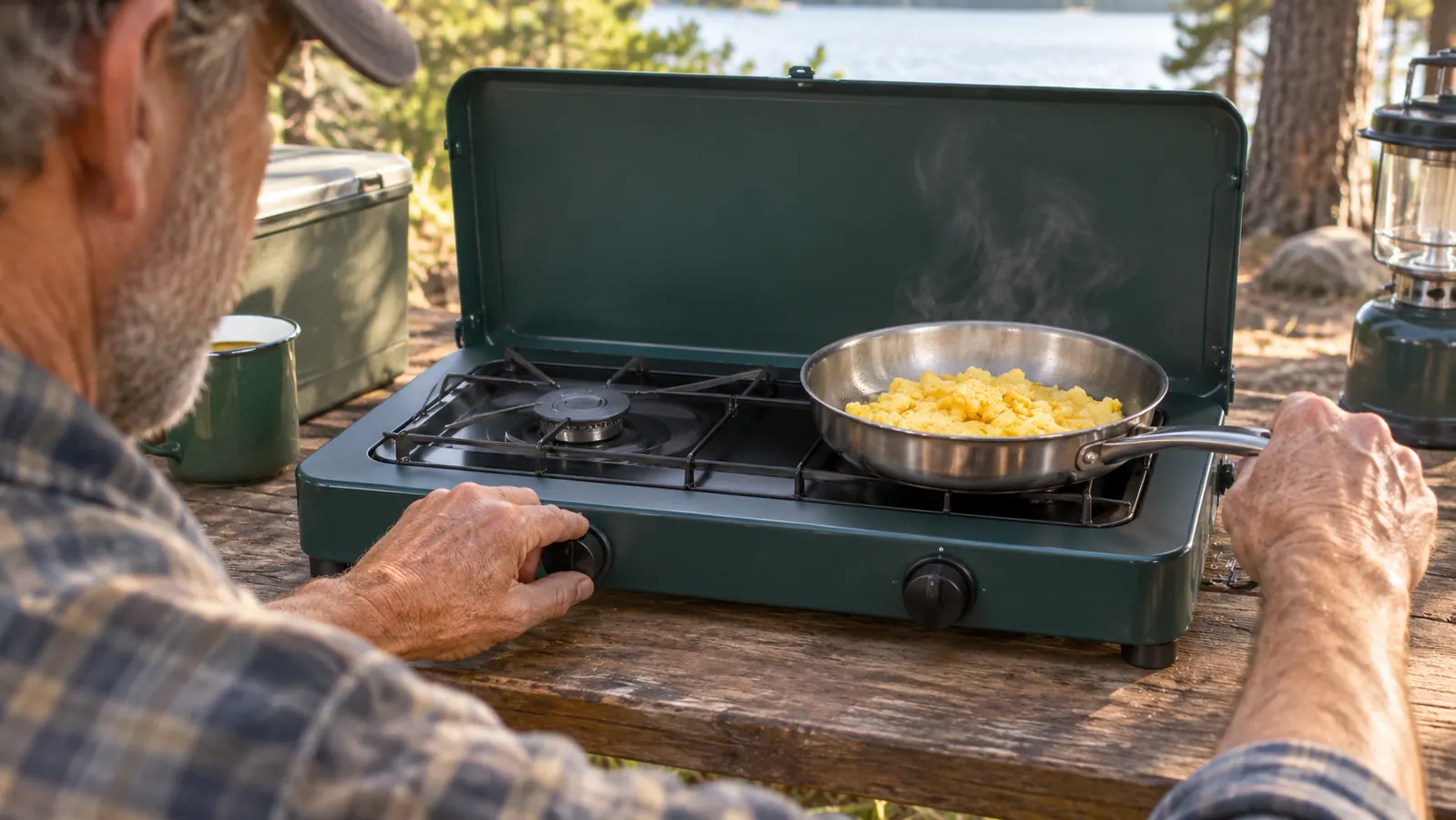
Here is the honest part of the honest review. The Coleman Triton has four quirks that you will not see in the marketing photos, and none of them are dealbreakers, but all of them are real.
First, the grate rattles. The two cooking grates sit on the burner assembly and they are not locked down. If you carry the stove by the handle with the grates in place, they clatter the whole way from the car to the picnic table. The first time I carried it from the back of the 4Runner to the table at Garner, my son Eli asked if I had a loose bolt in the case. That is the sound it makes. It is not a functional problem, the grates do not shift while you cook, but it sounds cheap and it makes you wonder if something is loose. I solved it by carrying the stove with one hand under the base, which works fine.
Second, the regulator hisses when the propane tank is running low. This is the one that made me think something was broken. It happened for the first time on a cold October morning at Pedernales Falls, with the coffee water halfway to a boil. About two-thirds of the way through a 16-ounce propane cylinder, the Triton starts to make a faint hissing sound from the regulator area. The flame stays steady and cooking is unaffected, but the first time you hear it, you will turn the stove off and check every connection. I did exactly that, went through the soapy-water routine with the spray bottle I keep in the camp bin, found nothing, and spent the rest of the trip waiting for the stove to explode. It never did. That is normal for this stove. It is not a leak.
Third, the handle can get hot. The carry handle is metal and it sits close to the burner area. If you grab it while the stove is running or just after you turn it off, it is warm enough to be uncomfortable. I have never burned myself, but I have done the quick hand-switch dance more than once. It takes about three minutes to cool enough to grab comfortably, so I have learned to let it sit before I move the stove.
Fourth, and this is more of a nitpick, the folding wind screen that lives in the lid does not stay put in a stiff breeze. It is hinged at the back and it wants to flop forward when the wind hits it from the wrong side. On a gusty afternoon at Garner last September, it fell flat twice before I wedged a water bottle against it. Once you know the trick, it is fine, but it is the kind of thing you figure out at the campsite, not from the product page.
The regulator hiss scared me the first time I heard it. I turned the stove off, checked every connection with soapy water, found nothing, and eventually learned it just means the tank is running low.
What Genuinely Works Well
Now the part that keeps me recommending the Coleman Triton to every friend who asks. The two burners are genuinely independent, which sounds like it should be the bare minimum but is not always true at this price. I can run the left burner at full blast to boil water for pasta while the right burner simmers a pan of beans at the lowest setting. The knobs have a nice, solid click at each setting, and the low end is low enough to keep a pan of grits warm without scorching the bottom.
A typical Saturday morning at Garner goes like this: left burner on high with a 2-quart pot of water for coffee, right burner on its lowest setting with a pan of scrambled eggs and chorizo. Both come together within a couple of minutes of each other, and the low end is genuinely low. On the old canister stove, low meant the flame guttered and the pan scorched. On the Triton, I can hold a pan of refried beans at a bare simmer for twenty minutes while the bacon finishes, and nothing sticks to the bottom.
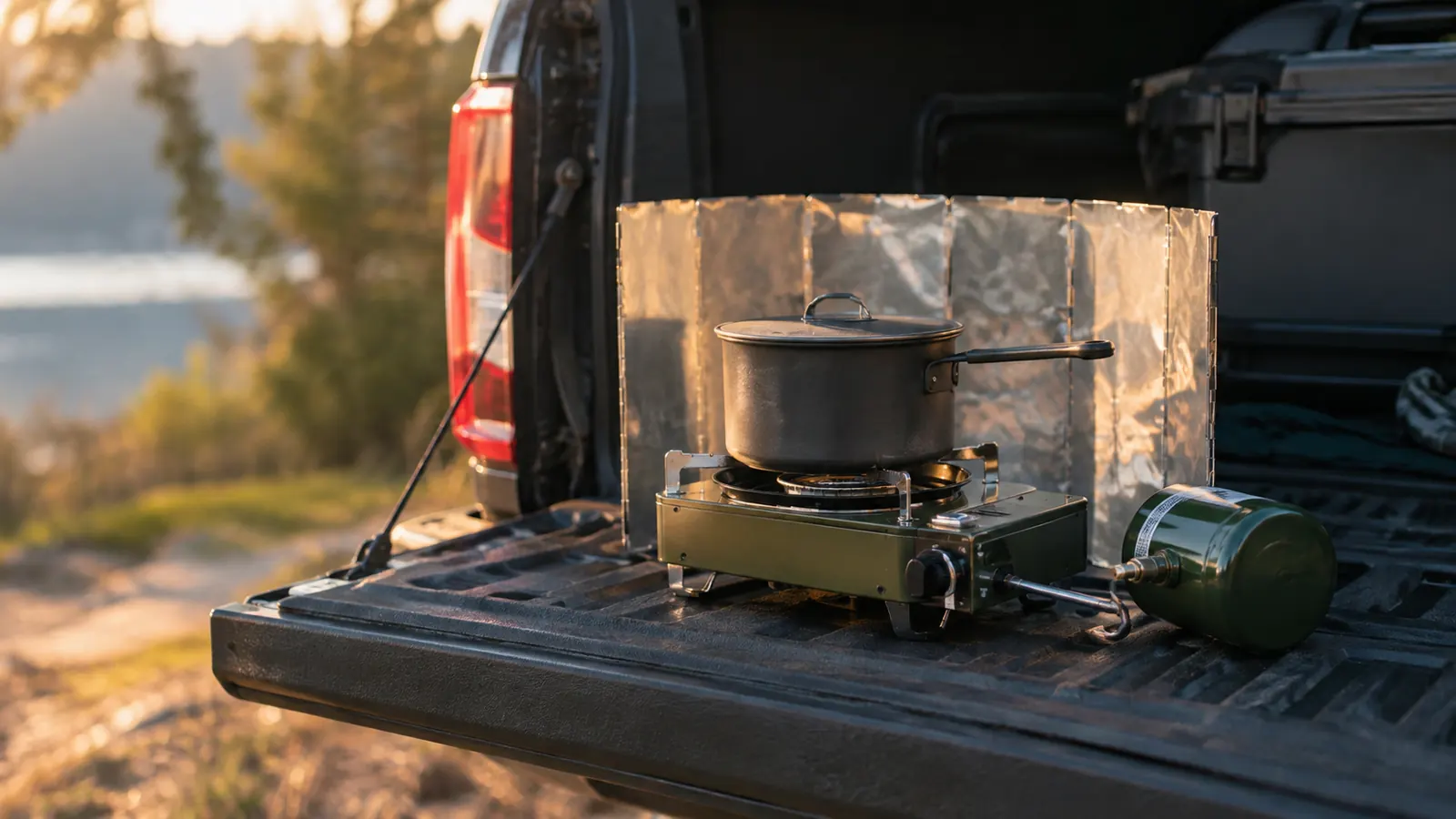
The wind performance is better than I expected for a stove in this price range. The burners sit recessed below the grate, which helps a lot. At Garner, where the afternoon breeze comes straight off the river, I can cook with the wind screen up and the flame stays where it should. It is not a windscreen like you would buy for a backpacking stove, it is a folding metal panel that comes attached to the lid, and it does a respectable job. On the coldest Colorado morning, with the wind screen up and the stove parked against the tailgate, I boiled water for coffee in maybe four minutes. The wind screen deserves its own note, because it is the feature I was most skeptical about. It is a thin metal flap that folds out of the lid, and it looked like it would bend the first time a gust hit it. It has not bent. It has been through a thunderstorm at Pedernales Falls and a week of cold wind in the mountains, and it still snaps back into place.
The Coleman Triton also lights reliably. I have never once had to fiddle with the igniter. It is a piezo push-button start, one click per burner, and it has worked on the first click every single time across roughly 40 cooking sessions. That matters more than people give it credit for. The old single-burner stove needed a lighter and a steady hand, and on a windy morning that was a two-person job.
And the clean-up is genuinely easy. The grates lift right off, the burner pan underneath wipes down with a paper towel, and the whole thing folds into a case about the size of a small suitcase. It takes up less room in the 4Runner than the old camp table we used to bring, and it fits flat in the back with the tent and the cooler.
The Numbers That Matter
The Coleman Triton runs on standard 16.4-ounce propane cylinders, the green ones you can buy at any hardware store. A single cylinder lasts us about three full camping weekends, which works out to roughly six breakfasts, a few lunches, and several pots of coffee. The math has held up across more than a dozen trips. One cylinder cooked six breakfasts, four lunches, and about ten pots of coffee before the hiss started. A second cylinder got us through the rest of that trip and halfway into the next one. I have learned to read the hiss as a fuel gauge, which means I have never once run out of propane mid-egg. That is the whole game for a camp stove: you do not want to be the person holding a cold skillet at 7 a.m.
The stove puts out somewhere in the neighborhood of 20,000 total BTU across both burners. I have never measured it with a gauge, but I can tell you the practical difference: it boils a 2-quart pot of water for coffee in about four minutes on a calm morning and about five when the wind is up. I timed it more than once because I am that person. On a calm morning with the wind screen up, the same 2 quarts came to a rolling boil in three minutes and fifty seconds. With the wind screen down and a breeze coming off the river, it took about five and a half. The difference matters on a cold morning, which is why the wind screen is the first thing I flip up. That is fast enough that I stopped bringing the old electric kettle, which was one more thing to pack and one more thing to find an outlet for.
The cooking surface is wide enough for a 12-inch skillet and a 2-quart pot at the same time, which is the exact combination that makes camp breakfast work for three people. I have also fit a 10-inch pan and a percolator side by side, and that works too, though there is not much spare room between them.
What I Would Change
If Coleman asked me, here is what I would change about the Triton. First, lock the grates down. A simple clip on each side would kill the rattle and make the stove feel twice as solid. Second, add a low-fuel indicator or at least a note in the manual that says the hiss is normal. That one sentence would have saved me a solid ten minutes of paranoia at a cold campsite. Third, put a heat shield on the carry handle. It does not need to be fancy, just a piece of silicone or a wider grip, so you do not have to remember to let it cool before you move it.
None of those changes would make me like the stove more. They would just make it easier to recommend without the caveats. As it is, I recommend it with the caveats, because the cooking performance is so much better than anything else I have used at this price.
How It Compares to What I Used Before
Before the Coleman Triton, we cooked on a single-burner backpacking canister stove. It was fine for boiling water and it packed small, but it could not cook a real breakfast for three people. Someone always ate cold cereal while the eggs finished. The Triton replaced that stove entirely, and I have not packed the old one once since.
I have also used friends' stoves at group campsites, including a Camp Chef Everest that a friend from Austin brings to the group trip every spring. The Everest feels more solid, the grates sit heavier, and it has a bigger cooking surface, but it is also noticeably heavier to lift out of a truck bed and it costs a good deal more. For the way we camp, a few times a season out of the back of a 4Runner, the Coleman Triton is the right amount of stove. The Everest is the stove I would buy if I cooked for eight people every weekend. I do not.
What I Liked
- Two genuinely independent burners with a real low simmer setting
- Piezo ignition that has lit on the first click every time across 40+ sessions
- Attached wind screen that handles a typical Hill Country breeze
- Grill grates lift off for easy cleanup
- Runs on standard propane cylinders you can buy anywhere
- Strong value for a family weekend-camping stove
Where It Falls Short
- Cooking grates rattle when you carry the stove
- Regulator hisses as the tank runs low, which is alarming the first time you hear it
- Metal carry handle gets hot near the burner area
- Wind screen flops forward in a stiff gust until you prop it
Who This Is For
Buy the Coleman Triton if you are a weekend car camper who wants to cook real food at the campsite without a lot of fuss. It is ideal for families of three or four, for couples who like a hot breakfast, and for anyone who has been making do with a single burner and is tired of eating in shifts. It is also a great first stove if you are just getting into camping and do not want to spend a lot of money on something you might use six times a year.
It is especially good for Texas camping, where the weather can go from calm to windy in ten minutes. The attached wind screen handles the breeze, the reliable igniter handles the cold mornings, and the wide cooking surface handles the actual meal. That combination is hard to beat at this price.
Who Should Skip It
Skip the Coleman Triton if you are a backpacker who carries everything on your back. At this size and weight, it is a car-camping stove, full stop. You want a lightweight canister stove that fits in a pot. Skip it if you need to cook for a big group, say eight or more people, because two burners will not keep up with that much food. And skip it if you are the kind of person who will be bothered by the rattle and the hiss no matter how well the stove cooks. Those quirks are real, and they are not going away.
I would also say this: if you already own a two-burner stove that works, you do not need this one. The Coleman Triton is a great value, but it is not magic. It is a well-made, honest stove that does exactly what it promises, and that is the whole pitch.
Still the stove I pack first after 18 months of weekends
The Coleman Triton has cooked breakfast for my family on a dozen trips, in wind, rain, and freezing cold, and it has never once failed to light. If you are shopping for a two-burner stove, this is the one to compare everything else against.
Amazon Check Today's Price on Amazon →